Advanced on page SEO made simple.

Powered by POP Rank Engine™
Includes AI Writer
7-day refund guarantee
Search optimization is entering a new phase as large language models influence how content is evaluated, summarized, and surfaced across search results. Google and other platforms are no longer relying only on traditional ranking signals. They are interpreting meaning, intent, and contextual relevance at scale. This shift is changing how pages earn visibility and how businesses should approach on-page SEO.
For teams focused on organic growth, the future of LLMs in SEO is not theoretical. It is already shaping how pages are crawled, interpreted, and selected for prominent placements. Page Optimizer Pro was built around correlational analysis, which aligns closely with how modern search systems evaluate page-level signals. That alignment positions on-page SEO as a central lever in an environment influenced by language models and generative systems.
Understanding how LLMs intersect with SEO allows businesses to adjust content workflows without losing control of performance or quality. The goal is not automation for its own sake. The goal is clarity, relevance, and measurable improvement.
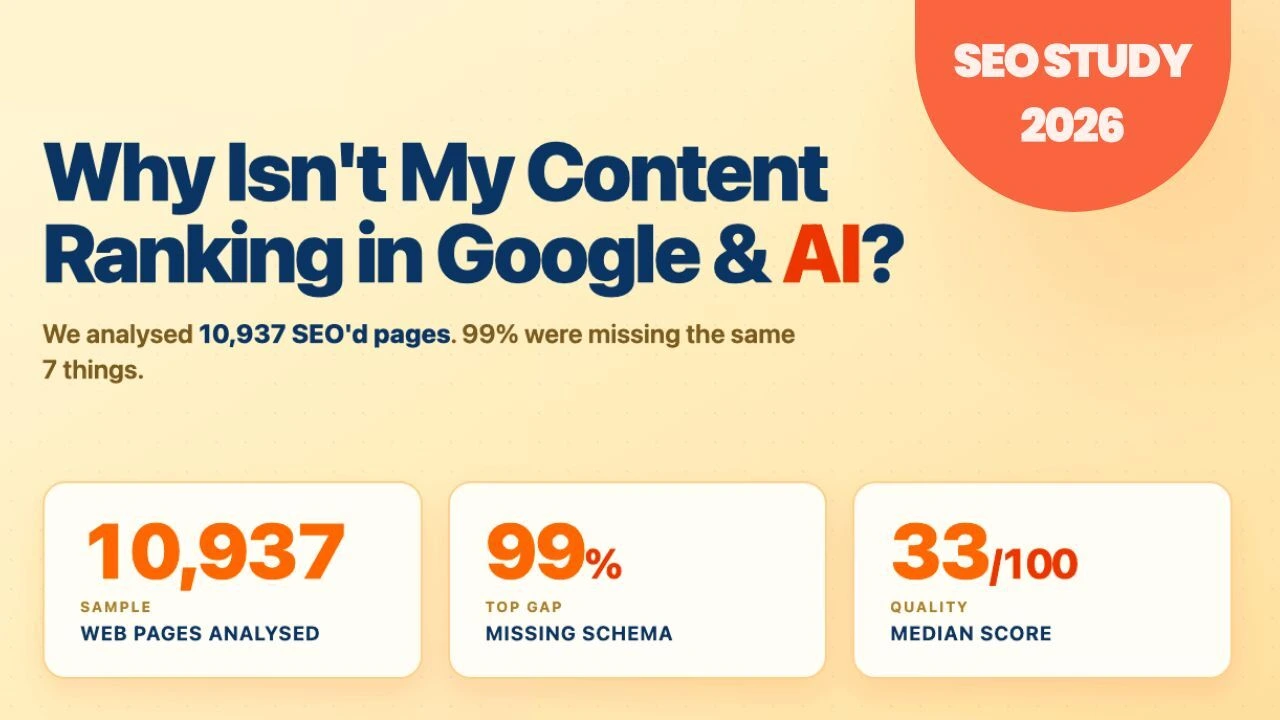
We analysed 11 industries. One averaged a POP Score of just 14.8 out of 100. Where does yours rank?
See how your industry compares, where the biggest gaps are, and which basics competitors still miss.

%20(1).png)

Which is the best LLM for SEO content?
Get the full rankings & analysis from our study of the 10 best LLM for SEO Content Writing in 2026 FREE!
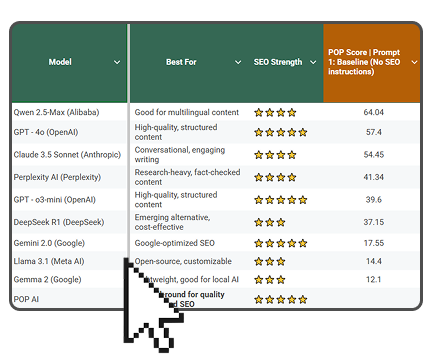
- Get the complete Gsheet report from our study
- Includes ChatGPT, Gemini, DeepSeek, Claude, Perplexity, Llama & more
- Includes ratings for all on-page SEO factors
- See how the LLM you use stacks up
How Large Language Models Are Reshaping Search Evaluation
Large language models process text differently than earlier search algorithms. Instead of relying heavily on individual keywords, they assess how concepts relate to each other across an entire page. This means structure, topical coverage, and contextual clarity carry greater weight in organic search.
Search systems powered by language models aim to match user intent with content that answers questions clearly and efficiently. Pages that explain topics in a structured and readable way are easier for these systems to interpret. As a result, on-page SEO is
becoming less about isolated terms and more about how ideas are connected.
This change has practical implications for content teams. Pages that rely on shallow explanations or scattered sections are harder for language models to evaluate. Pages that follow a logical flow, support main ideas with relevant details, and maintain consistent terminology are easier to parse and surface.
LLM SEO and the Rise of Answer-Focused Results
Web search behavior is shifting toward direct answers. Users increasingly expect search results to provide clear responses without requiring multiple clicks. This has led to the growth of answer engines and generative answers and results that summarize information directly on the results page.
In this context, SEO success depends on how well a page communicates information. Clear headings, direct explanations, and well-organized sections help search systems identify which parts of a page can satisfy specific queries. Content that addresses related questions naturally within the main body is more likely to be referenced or summarized.
This does not mean traditional organic listings are disappearing. It means pages must support both discovery and interpretation. A page still needs to rank, but it also needs to be understood well enough to be selected as a source.
Which is the best LLM for SEO content?
Get the full rankings & analysis from our study of the 10 best LLM for SEO Content Writing in 2026 FREE!
- Get the complete Gsheet report from our study
- Includes ChatGPT, Gemini, DeepSeek, Claude, Perplexity, Llama & more
- Includes ratings for all on-page SEO factors
- See how the LLM you use stacks up
Building Modern SEO Workflows with LLMs and Data
Large language models are increasingly used within SEO workflows to assist with drafting, rewriting, and content expansion. When applied correctly, they reduce friction and speed up iteration. When applied without validation, they introduce risk.
A sustainable workflow starts with intent definition. Before content is written or updated, teams should clarify what the page needs to accomplish and who it serves. An LLM can then help generate an initial structure or draft that reflects that intent.
Once a draft exists, an on page optimization tool, like Page Optimizer Pro, becomes the validation layer. By comparing the page against top-ranking competitors, teams can identify gaps, overuse, or missing elements. This step ensures that edits are grounded in observable patterns rather than assumptions.
From there, revisions should focus on clarity first. Sections that feel dense can be simplified. Transitions can be improved so the page reads smoothly from top to bottom. Terminology can be adjusted to match how topics are discussed across strong results.
This combination allows teams to move quickly without sacrificing control. Language models handle drafting support. Correlational data guides optimization. Human judgment ensures accuracy, tone, and alignment with brand standards.
Adapting On-Page SEO Optimization for Evolving Crawlers
As search systems learn to adopt language model capabilities, crawlers are becoming better at understanding context and relationships. This does not remove the need for optimization. It changes what optimization looks like.
Pages should now be built around clear themes rather than fragmented keyword targets. Headings should reflect real questions and topics users care about. Supporting paragraphs should explain those topics without unnecessary filler.
Structured data also plays a role in helping search systems interpret content. While schema alone does not guarantee visibility, it provides additional clarity when paired with strong on-page signals. When structure, language, and data align, pages are easier to evaluate and classify.
Page Optimizer Pro helps teams adapt to these changes by showing which elements consistently appear in strong results. This includes content length ranges, term usage patterns, and structural signals. Instead of reacting to every algorithm update, teams can rely on observed correlations that remain stable across competitive SERPs.
This approach supports long-term adaptability. As search systems continue to evolve, pages built on clear structure and validated signals are better positioned to maintain visibility.
Positioning Your SEO Strategy for Long-Term Performance
The future of LLMs in SEO points toward a more interpretive and intent-driven search environment. Success in this environment requires balance. Automation can support speed, but data and strategy must guide decisions.
Teams that rely solely on language models risk publishing content that sounds polished but lacks competitive alignment. Teams that rely solely on legacy SEO tactics risk falling behind as search interpretation improves. The strongest results come from combining both approaches.
Page Optimizer Pro provides a framework for this balance. By grounding content decisions in correlational analysis, it helps teams focus on what actually influences performance. When paired with thoughtful use of language models, this framework supports consistent improvement across new content and existing pages.
If you want your content to align with how modern search systems evaluate pages, Page Optimizer Pro helps you identify and apply on-page changes backed by real competitive data. Use it to refine drafts, improve existing URLs, and support measurable SEO growth as search continues to evolve.
We analysed 11 industries. One averaged a POP Score of just 14.8 out of 100. Where does yours rank?
See how your industry compares, where the biggest gaps are, and which basics competitors still miss.


Kyle Roof is a Co-Founder & Lead SEO at POP, SEO expert, speaker and trainer. Kyle currently resides in Chiang Mai, Thailand with his family.